
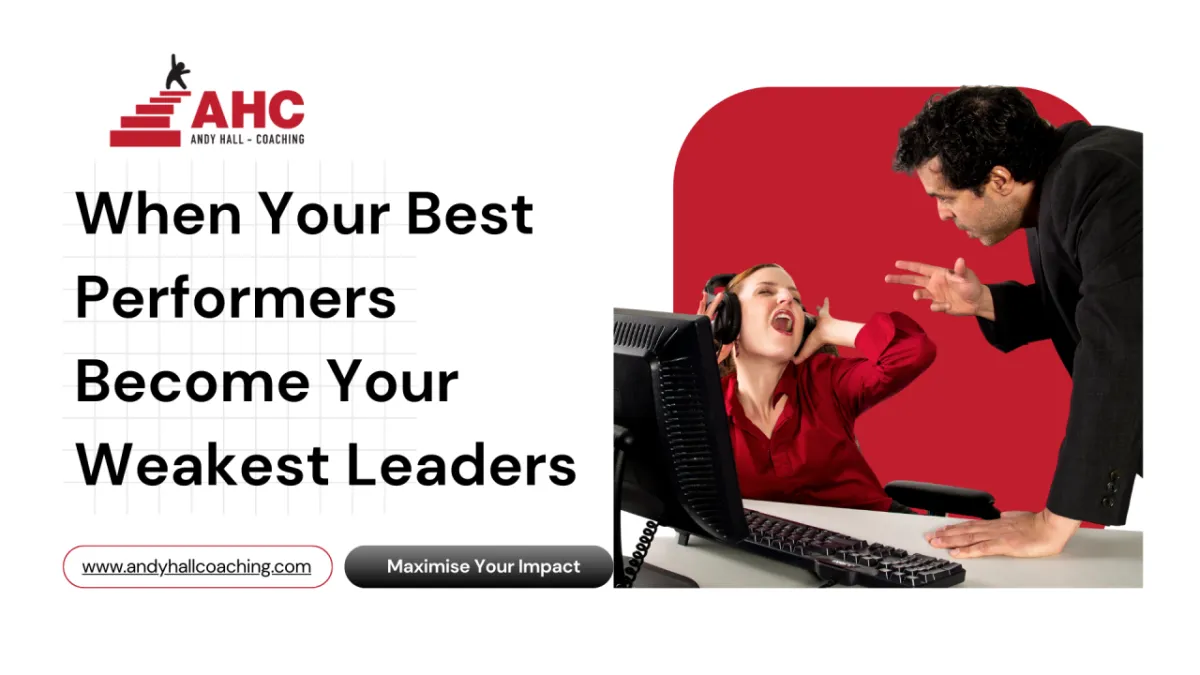
When Your Best Performers Become Your Weakest Leaders
Many CEOs hit a frustrating pattern as they scale: they promote their top performers, expecting the same success, only to watch them struggle in leadership roles.
According to Gallup, only 10% of promoted employees succeed naturally as managers without targeted development. Technical skill does not automatically translate into leadership impact.
The Hidden Cost of Promotion Without Coaching
When high performers are promoted without learning leadership skills, organisations experience hidden drag. Micromanagement creeps in. Decisions get delayed. Teams disengage because their leaders are inconsistent or unclear.
This isn’t a personal failure, it’s a systemic one. Leaders need a new skill set: the ability to guide, influence, and develop others rather than just execute themselves.
How Coaching Bridges the Gap
Coaching equips these new leaders to think critically, have challenging conversations, and build ownership in their teams. Research from the International Coaching Federation shows that leaders who are coached see 70% improvement in team performance metrics within six months.
Through coaching, high performers transition into high-impact leaders who can scale their influence, rather than creating new bottlenecks.
The Risk of Doing Nothing
Ignoring this challenge comes at a high cost. McKinsey finds companies with weak middle leadership underperform peers by up to 30% in revenue growth. High performers may disengage or leave entirely, while teams struggle under inconsistent guidance. Your company may hit a growth ceiling without realising its potential.
Reflection for CEOs
Which of your top performers are struggling in leadership roles? What structures are in place to support them in thinking and leading effectively?
What to do next?
The Leader As A Coach program helps organisations transform top talent into strong, independent leaders. If you want to prevent bottlenecks and unlock the full potential of your leadership team, let’s start a conversation.